
Black Female Intellectuals in Nineteenth Century America: Born to Bloom Unseen?
| Review Number: | 2486 |
|---|---|
| Publish Date: | Wednesday, 8 January, 2025 |
| Author: | Rebecca J. Fraser |
| ISBN: | 9781032210094 |
| Date of Publication: | 2023 |
| Price: | £28.79 |
| Pages: | 212pp. |
| Publisher: | Routledge |
| Publisher URL: | https://www.routledge.com/Black-Female-Intellectuals-in-Nineteenth-Century-America-Born-to-Bloom-Unseen/Fraser/p/book/9781032210094?srsltid=AfmBOopiuahhb0Ib0fLRg5dxh6dXTA2rXUzciuf17aehjV1qZqmj2xlz |
| Place of Publication: | New York |
| Reviewer: | David G. Cox |
Twenty years ago, at the start of his monumental Conjectures of Order, Michael O’Brien suggested that ‘intellectual history is not a democratic venture,’ and was, therefore, ‘somewhat illegitimate in the modern discipline of history, which has made much of the moral importance of inclusiveness and equality.’[1] Rebecca Fraser’s Black Female Intellectuals in Nineteenth Century America: Born to Bloom Unseen? is the latest in a body of scholarship that upends O’Brien’s characterisation. In the hands of Fraser, intellectual history is nothing if not inclusive and egalitarian. To O’Brien, it was the ‘cold truth’ that this mode of history was concerned with ‘clever people who once expressed themselves in complicated patterns, which other clever people have taken seriously.’ Whilst cleverness was ‘personal,’ he argued, it was also ‘authorized by society,’ which governed access not only to literacy and publication but also critical legitimacy. As Fraser recognises, in the nineteenth-century American public sphere, dominated and policed by middle-class whites, the cleverness of Black women was ignored. In an 1832 lecture delivered to the New England Anti-Slavery Society, the Black abolitionist and writer, Maria W. Stewart, made this clear, inveighing against a white-supremacist society that ensured ‘there are many flowers among us that are born to bloom unseen’ (p. 1).
Fraser borrows Stewart’s metaphor for the subtitle of her book, furnishing it with an interrogation point (Born to Bloom Unseen?). It soon becomes clear that the question is rhetorical. Nineteenth-century Black female intellectuals have been seen, argues Fraser, not only by historians engaged in the act of recuperation but also, and more importantly, by the Black public cultures within which they thought and worked, as well as by subsequent generations of Black thinkers. Although conceived independently, Fraser’s book acts as a response to the published work of Mia Bay and the Black Women’s Intellectual and Cultural History (BWICH) Collective. In the introduction to their 2015 edited collection, Toward an Intellectual History of Black Women, Bay and the other editors invited intellectual historians to turn their attention to the ‘largely neglected’ sphere of Black women’s thought.[2] Invariably viewed as activists or the objects of thought, they argued, Black women needed to be considered as ‘producers of knowledge.’[3] Fraser does just this. Nobody will come away from this book under any doubt that nineteenth-century Black female intellectuals were, to paraphrase O’Brien, clever people taken seriously by other clever people.
As Bay and her fellow editors noted, the study of Black women’s thought raises questions for the entire field of intellectual history. ‘Under what conditions,’ asked BWICH, ‘may ideas be produced and where should we look for them?’[4] With rigour and creativity, Fraser answers both of these queries. With a background in the social history of slavery, Fraser excels in fine-grained analysis of the conditions within which Black women thought, wrote, and spoke. For Black female intellectuals, labouring under the twinned burdens of racialized and gendered oppression, a room of one’s own was a vanishingly-remote possibility. Whether enslaved or free, northern or southern, members of the Black middle class or not, life remained marked, in the words of Maria W. Stewart, by ‘drudgery and toil’ (p. 8).
In answer to BWICH’s second question, Fraser looks for the ideas of Black female intellectuals in ‘unexpected places’ (p. 82). In so doing, she draws upon the work of literary critics like Eric Gardner, whose scholarship is part of an ‘archival turn’ in the study of Black literature.[5] Looking beyond published books, these critics have identified a vibrant nineteenth-century print culture rooted in Black periodicals. As Gardner has argued, the African Methodist Episcopal (AME) Church’s Christian Recorder is an especially rich source of periodical literature. Evidencing Frances Smith Foster’s contention that the Black Church catalysed and sustained Black literature, the Recorder published a corpus of poems, essays, serialized novels, and correspondence.[6] This body of literature, much of it written by Black women, has proved invaluable to recent scholars, including, now, Fraser. However, Fraser does not confine her analysis to periodical literature, she casts her net further still. According to Fraser, Black women’s intellectual production encompassed not only periodical literature but also art and bodily performance. This is Fraser’s most interesting theoretical innovation, pointing intellectual historians towards new kinds of sources. After all, as Toni Morrison put it, ‘All good art is political!’[7]
Fraser begins with the body. In the South, argues Fraser, the brutal logic of racialized capitalism sought to strip Black women of subjectivity, defining them in terms of their (re)productive labour. In the North, Black women were similarly objectified. Here, they were ‘doubly discredited’ by a separate spheres ideology that denied women a public voice, as well as a racist popular culture that helped legitimise the denial of Black citizenship encoded in the Dred Scott decision. But Black female intellectuals fought back. One of the ways in which they did so was with bodily performances that challenged whites to ‘confront their own gender prejudice and racial bigotries’ (p. 19). Borrowing Lauren Berlant’s concept of diva citizenship, Fraser argues that these performances constituted a form of oppositional discourse, allowing Black women to make ‘claims to power’ (p. 30).[8] The chapter opens with a striking instance of diva citizenship. In 1858, Sojourner Truth addressed an anti-slavery meeting, the attendants of which included pro-slavery Democrats. At the close of the gathering, Truth was adjured to prove her sex, as some listeners had decided her voice was too deep for a woman’s. With startling (and, no doubt, intentional) disrespect, Truth was asked to exhibit her breasts to some female audience members. Even for those without Fraser’s formidable knowledge of antebellum slavery, the echoes of the slave auction are clear. Truth refused, however, insisting that she exposed herself to the entire audience. In a heroic reversal of the power dynamic, the formerly-enslaved abolitionist declared that ‘it was not to her shame that she uncovered her breast before them, but to their shame’ (p. 19). Discussing a range of Black female intellectuals— including Maria W. Stewart, Frances E. W. Harper, Mary Ann Shadd Cary, and Harriet Tubman—Fraser identifies several such acts of diva citizenship. Although these acts are visible mostly through the mediating and occluding lens of newspaper reports, it is clear, as Fraser demonstrates, that such ‘embodied discourse’ did not cleave as closely as Black women’s literature to the politics of respectability (p. 20).[9]
The second chapter turns to this literature, focusing on the letters, essays, and fiction written by Black women and published in the Christian Recorder. Black women’s correspondence, Fraser argues, was a means of engaging with public debates about Black citizenship and the rights of women, allowing them to command an audience beyond their immediate locality and, in so doing, ‘claim a voice within Black intellectualism’ (p. 53). Prominent among these women was Julia C. Collins, a Pennsylvanian teacher. The Recorder published several of Collins’s letters, and serialized her novel, The Curse of Caste. To Fraser, Collins’s writing—and that of other Black women published by the Recorder—was a form of social and political action, intended to spur other women to make their voices heard within the public sphere. For future activist-thinkers, it also served as a ‘model of Black female intellectual production’ (p. 58). As Fraser recognises, however, much of this writing seemed to do little more than parrot the politics of respectability. In the Civil War-era, letter after letter urged female readers to use their (current or future) status as wives and mothers to cultivate the intellectual and moral faculties of Black men, thus ensuring their readiness for citizenship. Essentially, these letters articulated a notion of race motherhood analogous to the white concept of republican motherhood.[10] And, like expressions of republican motherhood, articulations of race motherhood did little to challenge the ideology of separate spheres. This is, perhaps, unsurprising, considering the fact that the AME Church was a bastion of patriarchal conservatism, and that contributions to the Recorder were policed by its male editors. What was radical about the discourse featured in this chapter, however, was not so much its content as its creation. In a society seeking to render Black female intellectuals invisible, the very act of writing was revolutionary.
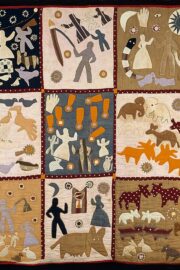
In the next chapter, Fraser focuses on a pair of Black women more likely to feature in art histories than intellectual ones. Firstly, Edmonia Lewis, a free person of colour, educated at Oberlin College and of dual First Nations and African descent. Lewis relocated to Rome in 1867, from whence she produced a series of figurative sculptures, working alongside (but rarely in harmony with) a group of white women who were also artists, and also American expatriates. Whilst committed to abolition, these white artists frequently evinced racist and culturally-condescending attitudes, as demonstrated by the letters of Lewis’s patron, Lydia Maria Child. The second Black artist is Harriet Powers, a formerly-enslaved woman from Georgia who produced quilts of exquisite beauty and great power. Both women, argues Fraser, should be viewed as intellectuals who ‘worked within a framework of liberation theory’ (p. 86). Indeed, Powers brings new meaning to O’Brien’s definition of intellectuals as ‘clever people who once expressed themselves in complicated patterns.’ In 11 pictorial panels, depicting Biblical scenes, her famous ‘Bible Quilt’ encapsulated an entire Black theology, fusing sacred and secular, African and European, present and future. Fraser opens this chapter with a description of the completion and sale of this quilt to a white teacher, Jenny Smith. Only a paragraph long, this passage is a virtuoso work of historical imagination, its single footnote listing nine different sources. Such attention to social detail is maintained throughout the chapter, as Fraser analyses the contexts within which Lewis and Powers worked. Lewis’s thought, as Fraser demonstrates, was shaped not only by the progressive politics of Oberlin but also by her experience as a Black woman in a world of white terror. In Italy, none of Lewis’s fellow artists approved of her isolationism and spendthrift behaviour, but, unlike Lewis, none of them had been left for dead in a near-lynching.
Having considered three modes of intellectual expression—embodied discourse, writing, and art—Fraser switches to a thematic approach. The next chapter unpicks the thread of Black Nationalism that ran through the thought of Black female intellectuals. Whilst making their voices heard within public debates regarding citizenship and freedom, Black female intellectuals ‘pushed against the gender dynamics of the era by claiming a space within the debates around Black Nationalism in the nineteenth century’ (116). At first glance, some of these thinkers make for unlikely Black Nationalists. Having been born free in Delaware, Mary Ann Shadd Cary moved to Pennsylvania where she worked as a teacher before emigrating to British Canada West in 1852 and singing the praises of the British Empire in A Plea for Emigration. In Canada West, Shadd Cary established and fiercely defended a racially-integrated school, before returning to the US during the Civil War to work as a recruiter for the 54th Massachusetts Regiment. What Shadd Cary’s life and work demonstrates, according to Fraser, is that nineteenth-century Black Nationalist thought was a spectrum, and that an individual’s place on this this spectrum was shifting and contingent. Borrowing from bell hooks, Fraser seeks to define Black Nationalism as the search for a ‘homeplace’ (130) rather than a static array of political, social, cultural, and economic positions.[11] This loose definition allows Fraser to argue that almost all of the Black female thinkers discussed in her book engaged, in one way or another, with the idea of Black Nationalism.
The next chapter analyses the relationship between Black pedagogy and racial-uplift ideology. Mary Ann Shadd Cary, Maria W. Stewart, and Julia C. Collins all earned their crust as teachers. Like Frederick Douglass, these thinkers viewed education as the sine qua non of intellectual and moral uplift. This elevation, they argued, was necessary not only to shatter stereotypes but also to provide the practical skills necessary to thrive in a free labour society. Whilst steadfastly opposed to notions of innate racial hierarchy, there was little in the rhetoric of these teachers to suggest that they had done anything other than buy into Euro-American discourses of cultural hierarchy. Few appear, at least on the surface, to have gone beyond respectability. In this, of course, they were no different from Alexander Crummell, George Washington Williams, or many Black male intellectuals whose thought has been more frequently considered by historians. As Julia C. Collins wrote in an 1864 Christian Recorder essay, the duty of teachers was ‘not only the improvement of the mind, but the cultivation and purity of taste’ (153). Taste, in this instance, meant the ability to discriminate between Victorian categories of high and low culture.
Of course, public rhetoric and lived experience are two very different things. We can never truly know the extent to which Black female intellectuals bought into Euro-American notions of cultural hierarchy. We can only know what has been left to us. As Saidiya Hartman has argued, ‘[h]istory pledges to be faithful to the limits of fact, evidence, and archive, even as those dead certainties are produced by terror.’[12] And, as Fraser notes, the voices of Black female intellectuals have been muted by a historical archive that stands as testimony to the patriarchal, white-supremacist society within which it was produced. In the nineteenth century, the gatekeepers of this archive rarely considered Black women’s thought worthy of record. Furthermore, as Fraser demonstrates in the concluding chapter, Black female intellectuals’ ability to articulate their thought was further ‘circumscribed’ by the harsh conditions of their life (169). This chapter acts as a coda for a book in which these material conditions have already featured prominently. Fraser’s decision to end rather than begin her monograph with this chapter is a wise one. It throws into even greater relief the heroic intellectual achievement of nineteenth-century Black women who took arms against a sea of troubles. The personal histories described are striking. Julia C. Collins died of consumption before completing The Curse of Caste. Edmonia Highgate was killed by an incompetent abortionist. Edmonia Lewis, accused of poisoning two friends at Oberlin, was beaten and left for dead. Frances E. W. Harper and Mary Ann Shadd Cary were verbally abused. Sojourner Truth and Harriet Tubman were assaulted by streetcar conductors. In light of all this, Fraser concludes, it is remarkable that these intellectuals managed to produce a body of knowledge that will be ‘forever seen’ (181).
Black Female Intellectuals in America: Born to Bloom Unseen? is a hugely impressive piece of scholarship, meticulously-researched and evincing a total mastery of an enormous range of secondary literature. There are, however, points at which Fraser might have further developed her analysis. Whilst Fraser sets out to explore the relationship between social context and thought, the former is, sometimes, afforded more space than the latter. To take one example, in the discussion of Harriet Powers, Fraser maps the social history of enslaved women’s quilting in great detail, but it would have been interesting to see her unpick more (intellectual) threads from Powers’s quilts themselves. This is to say that, on occasion, Fraser might have paid less attention to the context within which knowledge was produced and more to the characteristics of this knowledge. On occasion, an intellectual history such as this might be expected to more evenly balance base and superstructure.
At times, closer analysis could have opened the door to greater nuance. As an example, take Mary Ann Shadd Cary. In British West Canada, Shadd Cary fell out with another Black teacher, Mary Bibb, as well as her husband, the famous fugitive slave abolitionist, Henry Bibb. The Bibbs, who ran a school for African Americans, turned on Shadd Cary when she opened a racially-integrated school two miles away. Shadd Cary was outraged. Fraser sees Shadd Cary’s reaction as a heroic example of diva citizenship, a refusal to genuflect before the Black, male, émigré elite, and an expression of faith in the possibility of a ‘racially harmonious society’ (157). All this may be true, but Shadd Cary’s attitude towards Mary Bibb was also strikingly condescending. In a letter to the white Reverend George Whipple, attempting to solicit funds for her school from the American Missionary Association, Shadd Cary dismissed Mary Bibb as a ‘profane, swearing, and drug-taking woman’ who would be ‘discarded by heathens’ (157). On the one hand, this letter was a piece of rhetoric intended to persuade Whipple to part with cash; on the other, it evinced at least as much cultural condescension as anything that Lydia Maria Child wrote about the sculptor, Edmonia Lewis. If Shadd Cary is to be admitted to the pantheon of Black female intellectuals, why not Mary Bibb? And if the former, who ran an integrated school, contributed to Black Nationalist discourse, why not the latter, who ran one that excluded whites? Furthermore, elsewhere in the book, Fraser argues that Edmonia Lewis suffered from the ‘haunting traumas of slavery that were conveyed to her by those that had suffered them’ (160). Of course, one of those who had suffered them first-hand was Henry Bibb. This might help explain the fact that Bibb’s attitude towards whites was more wary than Shadd Cary’s. It might also cast a different light upon another source of contention between Shadd Cary and the Bibbs, Henry Bibb’s support for the Home Refugee Society’s policy of selling land only to formerly-enslaved fugitives, at the exclusion of free people of colour.
Such qualifications, however, should in no way detract from the quality of Fraser’s work. Readers will be left in no doubt that Black Female Intellectuals in America: Born to Bloom Unseen? is an invaluable addition to the intellectual history of Black women.
[1] Michael O’Brien, Conjectures of Order: Intellectual Life in the American South. Vol. 1 (Chapel Hill: University of North Carolina Press, 2004), 15-16.
[2] Mia Bay, Farah J. Griffin, Martha S. Jones, and Barbara D. Savage, eds., Toward an Intellectual History of Black Women (Chapel Hill: University of North Carolina Press, 2015), 1.
[3] Ibid., 2.
[4] Ibid., 9.
[5] See Britt Russert, ‘From Black Literature to Black Print: The Return to the Archive in African American Literary Studies,’ American Quarterly 68.4 (2016)” 993-1005.
[6] See Frances Smith Foster, Written by Herself: Literary Production by African American Women, 1746-1892 (Bloomington: Indiana University Press, 1993).
[7] Kevin Nance, ‘The Spirit and the Strength: A Profile of Toni Morrison,’ Poets & Writers Magazine (November/December, 2008). [https://www.pw.org/content/the_spirit_and_the_strength_a_profile_of_toni_morrison]
[8] See Lauren Berlant, The Queen of America Goes to New York City: Essays on Sex and Citizenship (Durham: Duke University Press, 1997).
[9] For the concept of ‘embodied discourse,’ see Brittany C. Cooper, Beyond Respectability: The Intellectual Thought of Race Women (Urbana: University of Illinois Press, 2017).
[10] For the concept of race motherhood, see Wilma King, The Essence of Liberty: Free Black Women During the Slave Era (Columbia: University of Missouri Press, 2008).
[11] See bell hooks, Yearning: Race, Gender and Cultural Politics (New York: Routledge, 2014).
[12] Saidiya Hartman, ‘Venus in Two Acts,’ Small Axe 12.2 (2008): 9.